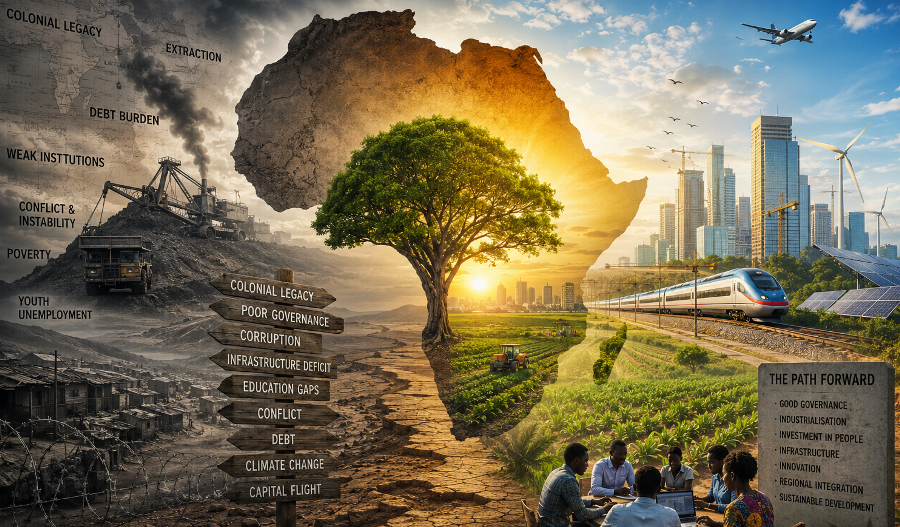
A WELL-RESEARCHED ROOT CAUSES OF AFRICA'S UNDERDEVELOPMENT
Africa is a continent of extraordinary wealth. It possesses vast quantities of oil, gas, gold, copper, cobalt, uranium, lithium, iron ore and other minerals. It has enormous agricultural potential, abundant sunlight, extensive forests, major rivers and a young and rapidly growing population. It is also home to some of the world's most important cultural and intellectual traditions.
Yet much of the continent remains trapped in poverty, unemployment, weak public services, low productivity and economic dependence.
This presents one of the great paradoxes of the modern world: how can a continent so rich in natural and human resources remain so poor in the ability to convert those resources into broad-based prosperity?
There is no single answer.
It is too simplistic to say that Africa is underdeveloped because of colonialism. It is equally simplistic to blame everything on African leaders, corruption or tribalism. Colonialism created historical structures that mattered enormously, but African governments and elites after independence also made choices that either reproduced or failed to dismantle those structures. External economic forces have also played an important role.
Africa's predicament is therefore better understood as a chain of causes. History created certain conditions; political institutions reproduced some of them; economic policies deepened others; and contemporary global pressures continue to exploit the weaknesses.
1. THE COLONIAL ECONOMIC STRUCTURE
One cannot seriously discuss African underdevelopment without beginning with colonialism.
European colonial rule did not primarily organise African economies around the objective of creating prosperous, diversified African societies. Colonial economies were largely organised around extraction and the supply of raw materials to imperial markets.
Railways, ports and roads were built in many territories, but their economic geography often reflected the requirements of extraction. Mines, plantations and agricultural producing areas had to be connected to ports through which commodities could be exported. Infrastructure was therefore frequently designed to move resources outwards, rather than to connect African economies to one another.
This distinction remains important.
An economy that exports cocoa but imports chocolate, exports crude oil but imports refined petroleum products, exports cotton but imports finished textiles, or exports minerals but imports manufactured goods has not escaped the basic structure of a primary-resource economy.
Colonialism also left behind uneven educational and administrative development. Colonial governments generally invested in education and administrative capacity according to their own economic and political requirements rather than according to the long-term needs of an independent African population.
The legacy was therefore not simply that Europeans took African resources. It was that they helped establish an economic pattern in which Africa supplied commodities and consumed manufactured products produced elsewhere.
The African Development Bank itself identifies colonial legacies alongside weak skills, institutional fragility, poor health conditions, inequality and other historical factors as part of the difficult starting position inherited by newly independent African states. African Development Bank
However, colonialism should not become an intellectual excuse for every failure since independence. Research on colonial institutions shows that their influence has varied considerably between countries and has diminished in importance in some cases, while contemporary institutions, political systems and pre-colonial conditions have become increasingly important. Cambridge University Press
The proper conclusion is therefore neither that colonialism explains everything nor that it explains nothing. It established an inheritance. What African societies did with that inheritance after independence became another part of the story.
2. THE FAILURE TO COMPLETE STRUCTURAL TRANSFORMATION
Perhaps the most important economic problem is that many African countries have never completed the transition from low-productivity economies to high-productivity economies.
Development normally involves a movement of labour and capital from activities producing little value per worker towards activities producing considerably more value. Farmers become more productive. Agro-processing develops. Manufacturing expands. Technology improves production. Services become increasingly sophisticated.
This process is known as structural transformation.
Much of Africa has struggled to achieve it.
The African Development Bank reported in its 2024 economic outlook that Africa's structural transformation has been slow and uneven. Agriculture employed about 42 per cent of Africa's workforce while its productivity remained far below the economy-wide average. In many countries, workers have moved from agriculture not into large-scale manufacturing but into low-productivity informal services. African Development Bank
This creates a particularly African form of economic stagnation.
A young person may leave farming and move to a city, but instead of obtaining a productive factory job, the person may end up selling goods by the roadside, driving a motorcycle taxi, operating a tiny shop or surviving through other informal activities.
The person has technically moved out of agriculture, but the economy has not undergone genuine industrial transformation.
This explains why economic growth figures can sometimes look impressive while ordinary citizens continue to experience unemployment and insecurity.
Growth is not the same thing as development.
An economy can grow because oil prices rise or mineral exports increase without creating enough productive employment for its population.
3. DEPENDENCE ON RAW MATERIAL EXPORTS
Closely connected to the failure of industrialisation is Africa's dependence on commodities.
Oil, minerals and agricultural commodities generate foreign exchange, but they also expose countries to fluctuations in international prices.
When oil prices rise, an oil-producing government may experience an apparent economic boom. When prices collapse, government revenues, foreign exchange earnings and public investment can suddenly fall.
UN Trade and Development reports that more than half of African countries depend on oil, gas or minerals for at least 60 per cent of their export earnings. It argues that commodity dependence leaves economies vulnerable to external shocks and makes diversification essential. UN Trade and Development (UNCTAD)
The deeper problem is the loss of value between the point of extraction and the point of final consumption.
Consider cocoa.
A country may produce enormous quantities of cocoa beans yet capture only a fraction of the value contained in the final chocolate product. The same principle applies to cotton and textiles, crude oil and refined petroleum products, or mineral ores and sophisticated manufactured goods.
The question Africa must ask is not simply:
“How much can we export?”
It is:
“How much value can we create before we export?”
That is the difference between an extractive economy and an industrial economy.
4. WEAK INSTITUTIONS AND THE POLITICS OF PERSONAL POWER
Another fundamental cause is institutional weakness.
A country does not develop simply because it has intelligent people. It develops when its institutions make productive behaviour possible and protect it over time.
Businesses need predictable laws. Investors need confidence that contracts will be honoured. Citizens need functioning courts. Public money must be subject to scrutiny. Government agencies need professional civil servants. Political transitions must occur without destroying the machinery of government.
Where institutions are weak, politics easily becomes a struggle for control of the state because controlling the state becomes one of the easiest routes to wealth.
This produces a vicious cycle.
Political power creates access to public resources.
Access to public resources creates private wealth.
Private wealth finances political power.
Political power is then used to protect the wealth.
The state gradually becomes less of an instrument for development and more of an instrument for distributing patronage.
The African Development Bank identifies weak institutions, corruption, limited domestic resource mobilisation and rising debt among the major governance challenges constraining inclusive growth and effective public services. African Development Bank
Research on African political institutions similarly finds that democratic contestation combined with institutional restraints on government authority can improve developmental governance. Cambridge University Press
The problem, therefore, is not simply whether a country holds elections.
The deeper question is whether the institutions surrounding political power are strong enough to prevent the state from becoming somebody's private possession.
5. THE CAPTURE OF THE STATE BY ELITES
Corruption is often discussed as though it were a disease that suddenly appeared in Africa.
It is more useful to see corruption as a symptom of a deeper political structure.
Where public institutions are weak and political office controls access to contracts, licences, land, natural resources and public employment, competition for political office becomes extraordinarily intense.
Politics becomes an economic investment.
People spend enormous sums to obtain political positions because the expected returns can be enormous.
This explains why corruption cannot be defeated merely by telling officials to become honest.
The incentives must change.
If a civil servant can steal millions and remain protected because of political connections, the system encourages corruption.
If an elected official can manipulate public contracts without meaningful consequences, corruption becomes rational behaviour within a dysfunctional system.
If the judiciary cannot operate independently, laws exist on paper but not necessarily in practice.
This is why institutional reform is more important than moral speeches.
6. THE FAILURE TO MOBILISE DOMESTIC RESOURCES
Development requires money.
Schools need money. Hospitals need money. Roads need money. Electricity systems need money. Universities, research institutions, water systems and public transport all require sustained investment.
Yet many African states have struggled to collect sufficient domestic revenue.
The World Bank notes that developing countries frequently struggle to raise enough tax revenue to finance education, infrastructure and essential public services, while low-income and fragile countries face particularly severe limitations. World Bank
This creates dependence on borrowing, aid and foreign investment.
But dependence on external financing can weaken a state's ability to determine its own development priorities.
There is also another side to the problem: money leaves Africa.
UNCTAD estimated that around US$88.6 billion a year left Africa through illicit capital flight, equivalent at the time to about 3.7 per cent of the continent's GDP. The flows include corruption, trade misinvoicing, tax evasion and other illegal financial practices. UN Trade and Development (UNCTAD)
This creates a devastating contradiction.
African governments complain about insufficient resources for development while enormous amounts of African wealth are moved outside the continent.
The issue is therefore not simply that Africa lacks money.
Africa also has a serious problem retaining and productively investing the wealth it generates.
7. DEBT AND THE COST OF FINANCING DEVELOPMENT
Borrowing is not inherently bad.
Every developing country needs capital, and well-managed borrowing can finance infrastructure, industrialisation and human development.
The problem begins when borrowing finances consumption, politically motivated projects, recurrent expenditure or projects that do not generate sufficient economic returns.
Debt then becomes a trap.
The situation has become more difficult because borrowing costs have risen internationally. UNCTAD reported in 2025 that sub-Saharan African governments spent 18.7 per cent of their revenues servicing external public and publicly guaranteed debt in 2024 — roughly three times the proportion recorded in 2014. UN Trade and Development (UNCTAD)
Money that could have built schools, hospitals, roads or electricity infrastructure is instead being used to service old obligations.
This creates another vicious circle:
low productivity leads to weak revenue;
weak revenue encourages borrowing;
borrowing increases debt-service obligations;
debt service reduces investment;
low investment keeps productivity low.
Breaking that circle requires more than simply borrowing additional money.
8. INFRASTRUCTURE DEFICITS
It is difficult to industrialise without electricity.
It is difficult to trade efficiently without roads, railways, ports and functioning border systems.
It is difficult to participate fully in the modern economy without telecommunications and reliable internet.
Africa's infrastructure deficit therefore has consequences far beyond physical inconvenience.
A manufacturer that has to operate expensive generators cannot compete easily with a manufacturer receiving reliable electricity from a national grid.
A farmer who cannot transport produce quickly to a major market loses part of the value of the harvest.
A manufacturer facing expensive transport and customs procedures may find it cheaper to import finished products than to produce them locally.
The African Development Bank has long identified inadequate energy, transport, water and telecommunications infrastructure as major constraints on structural transformation and competitiveness. African Development Bank
Infrastructure is therefore not merely a government welfare project.
It is productive capital.
9. EDUCATIONAL SYSTEMS THAT OFTEN PRODUCE CERTIFICATES WITHOUT SUFFICIENT PRODUCTIVITY
Africa has made enormous progress in expanding access to education, but access alone does not guarantee human-capital development.
A country can produce thousands of graduates every year and still suffer from a shortage of engineers, technicians, scientists, medical professionals, skilled artisans and technologically capable entrepreneurs.
There is often an uncomfortable mismatch between what schools and universities produce and what economies actually require.
Young people may spend years acquiring qualifications only to discover that the economy has not created enough productive employment for them.
This contributes to unemployment, underemployment and migration.
The problem is therefore not simply that Africa needs “more education”.
It needs better education connected to production, science, technology, agriculture, manufacturing and entrepreneurship.
A continent attempting to industrialise without developing its technical and scientific capabilities will remain dependent on imported knowledge and technology.
10. THE FRAGMENTATION OF AFRICAN MARKETS
Africa is politically divided into many relatively small national economies.
This fragmentation matters.
A factory producing goods for a small domestic market may struggle to achieve economies of scale. Yet if that same factory could sell easily across neighbouring countries, its potential market would become considerably larger.
Unfortunately, African trade has historically been hindered by poor roads, border delays, tariffs, non-tariff barriers, incompatible regulations and weak transport networks.
The African Continental Free Trade Area offers an opportunity to change this. The World Bank has estimated that full implementation could substantially increase African incomes and trade, but success depends on actually reducing the costs that prevent goods, services, capital and people from moving efficiently across borders. World Bank
Political leaders have spoken about African unity for decades.
The economic question is whether Africa can turn that political idea into a genuinely integrated economic space.
11. CONFLICT, INSECURITY AND POLITICAL INSTABILITY
No society can develop efficiently when large portions of its population are preoccupied with survival.
Conflict destroys roads, schools, farms, businesses and public institutions. It drives people from productive areas. It discourages investment. It consumes government resources that could otherwise be directed towards development.
It also creates a generation whose education and economic opportunities have been interrupted.
The African Development Bank notes that countries affected by fragility tend to experience deeper poverty, food insecurity, infrastructure deficits, weak public services, low economic diversification and institutional weaknesses. African Development Bank
The relationship also works in reverse.
Poverty, unemployment, inequality and exclusion can create fertile ground for political violence and armed conflict.
In other words:
underdevelopment can produce insecurity, while insecurity produces further underdevelopment.
12. THE FAILURE TO TURN AFRICA'S YOUTHFUL POPULATION INTO AN ECONOMIC ADVANTAGE
Africa's youthful population is frequently described as its greatest asset.
That is true only if young people are educated, healthy, skilled and productively employed.
Otherwise, a rapidly growing working-age population can become a tremendous social and economic burden.
Africa therefore faces a race against time.
Millions of young Africans enter the labour market every year. If productive jobs are created, the continent can enjoy a demographic dividend. If jobs are not created, unemployment and underemployment will intensify social pressure and migration.
The African Development Bank's current strategy explicitly identifies the difficulty of a youthful working-age population growing faster than jobs as one of the continent's major challenges. African Development Bank
The real question is therefore not whether Africa has a young population.
It is whether Africa can create a productive economy quickly enough to absorb it.
13. CLIMATE CHANGE IS TURNING AN OLD PROBLEM INTO A NEW ONE
Climate change is not the original cause of African underdevelopment, but it is increasingly making development more difficult.
Agriculture remains central to the livelihoods of millions of Africans. Droughts, floods, desertification, changing rainfall patterns and extreme temperatures therefore have direct economic consequences.
UNCTAD reports that climate hazards affected more than 110 million Africans in 2022 and caused an estimated US$8.5 billion in damages. UN Trade and Development (UNCTAD)
A poor country has fewer resources with which to adapt.
A wealthy country can build irrigation systems, flood barriers, resilient roads, insurance mechanisms and modern agricultural systems.
A poor country may simply wait for the next disaster.
Climate change therefore threatens to widen an existing development gap.
14. EXTERNAL ECONOMIC RELATIONS THAT KEEP VALUE LOW IN AFRICA
Africa does not operate in an economic vacuum.
Its countries compete in a global market whose rules, financial institutions, technologies and supply chains were largely developed outside the continent.
The problem is not that Africa trades with the rest of the world. International trade is essential.
The problem is the position from which Africa often enters that trade.
Countries that export raw materials and import finished products occupy a weaker position in global value chains than countries that control technology, finance, manufacturing, branding, logistics and distribution.
This is why simply increasing exports is not enough.
Africa needs to move upward in the value chain.
Instead of merely extracting minerals, it must increasingly process them.
Instead of merely producing agricultural commodities, it must develop agro-processing.
Instead of merely importing technology, it must increasingly develop technological capabilities of its own.
That is the path from an economy based on resources to an economy based on productive knowledge.
15. AFRICA'S UNDERDEVELOPMENT IS ALSO AN INTERNAL PROBLEM
There is a temptation to explain Africa's condition entirely through external forces.
That would be historically incomplete.
African societies themselves possess agency.
African governments have had decades of independence in which they could have strengthened institutions, invested in education, developed agriculture, industrialised, integrated markets and built accountable political systems.
Some have done better than others.
Botswana, Mauritius, Rwanda, Ghana and several other countries have demonstrated, in different ways and with different limitations, that African states are capable of achieving considerable institutional and economic progress.
This matters because it destroys the argument that Africa is somehow condemned to underdevelopment.
It is not.
The differences between African countries themselves demonstrate that institutions, leadership, policy choices and social organisation matter.
Colonialism created part of the terrain.
Africans are now responsible for what they build upon it.
THE CENTRAL PROBLEM: AFRICA HAS NOT YET BUILT ENOUGH PRODUCTIVE POWER
When all these factors are brought together, a deeper pattern becomes visible.
Africa's central development problem is not simply poverty.
It is insufficient productive power.
A productive economy does not merely consume. It produces.
It does not merely export raw materials. It adds value.
It does not merely import technology. It develops technological capacity.
It does not merely educate people to pass examinations. It develops people capable of solving economic and scientific problems.
It does not merely collect taxes. It converts public revenue into productive infrastructure and services.
It does not merely elect governments. It builds institutions that survive governments.
This is why the usual development debate often misses the central point.
A country can receive billions of dollars in loans and aid and still remain poor.
It can possess oil and minerals and still remain poor.
It can build universities and still remain poor.
It can hold elections and still remain poor.
It can experience periods of high economic growth and still remain poor.
Unless these things contribute to the creation of productive capacity, the underlying structure remains unchanged.
CONCLUSION: AFRICA MUST MOVE FROM EXTRACTION TO CREATION
The root causes of Africa's underdevelopment are therefore neither purely foreign nor purely African.
They are historical, political, economic, institutional and social.
Colonial rule established extractive economic structures and left behind uneven institutions. Post-independence political systems sometimes reproduced those structures through elite patronage, corruption and weak accountability. Commodity dependence exposed economies to external shocks. Failure to industrialise kept millions of people in low-productivity activities. Infrastructure deficits raised the cost of doing business. Weak education and technical capacity restricted innovation. Conflict destroyed productive assets. Fragmented markets prevented economies of scale. Debt reduced fiscal space. Capital flight drained resources. Climate change is now making many of these problems harder to solve.
Yet none of these conditions is irreversible.
The continent possesses something that no foreign aid programme can manufacture: a huge population, enormous natural resources, a vast potential internal market and an increasingly educated generation of young Africans.
The task is to combine these assets with institutions capable of protecting productive investment.
Africa does not need to be rescued.
It needs to become increasingly capable of producing, processing, innovating, financing and trading on its own terms.
The ultimate measure of development should therefore not be how much foreign assistance an African country receives, how many minerals it exports or how impressive its annual growth rate appears.
The real measure is much harder:
Can the country create enough productive wealth to provide its people with decent livelihoods without continually depending on someone else to finance its future?
That is the question at the heart of Africa's development challenge.
And until Africa moves decisively from an economy that largely extracts and exports to one that produces and creates, the continent's enormous wealth will continue to coexist with unacceptable poverty.