Kabbalah Explained: Ancient Wisdom, Tree of Life and Consciousness
Kabbalah (from the Hebrew root “to receive”) is one of the most profound systems of ancient wisdom. At its core, it is not merely a religion, a philosophy, or a mystical curiosity—it is a science of consciousness and existence. It seeks to answer the deepest questions: What is the origin of reality? What is the purpose of human life? How can one align with the divine order?
1. The Central Idea: From the Infinite to the Finite
Kabbalah begins with the concept of the Infinite—often referred to as Ain, Ain Soph, and Ain Soph Aur:
• Ain — Absolute Nothingness (beyond existence)
• Ain Soph — The Infinite (boundless being)
• Ain Soph Aur — Infinite Light (the first expression)
These are not “things,” but states of reality beyond comprehension. From this Infinite emerges all existence—not by creation in the ordinary sense, but through a process called emanation.
Emanation means that everything that exists is not separate from the source, but rather a gradual unfolding of it—like light radiating from a hidden sun.
2. The Tree of Life: The Structure of Reality
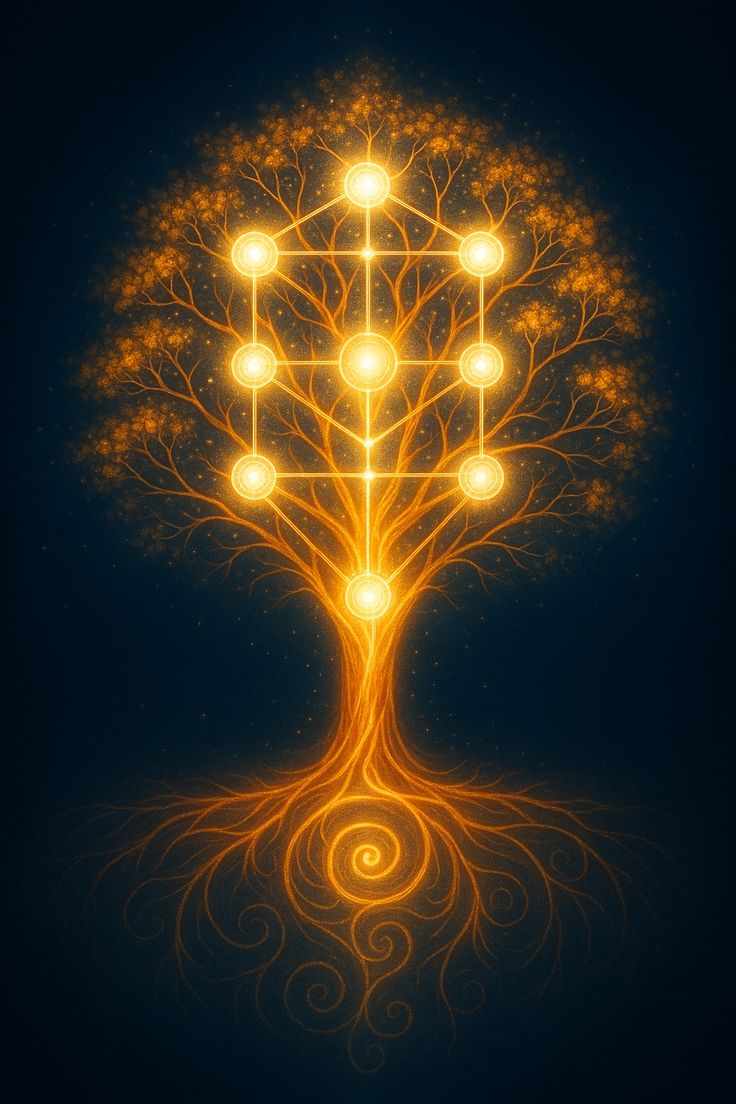
At the heart of Kabbalah is the Tree of Life, a symbolic diagram that maps the structure of existence and consciousness.
It consists of ten Sefirot (emanations), which are stages through which the Infinite becomes manifest:
1. Keter (Crown) — Pure will, divine intention
2. Chokmah (Wisdom) — Creative impulse
3. Binah (Understanding) — Form-giving intelligence
4. Chesed (Mercy) — Expansion, love
5. Gevurah (Severity) — Limitation, discipline
6. Tiferet (Beauty) — Harmony, balance
7. Netzach (Victory) — Endurance, desire
8. Hod (Glory) — Intellect, communication
9. Yesod (Foundation) — Connection, subconscious
10. Malkuth (Kingdom) — Physical reality
These are not separate entities—they are aspects of one unified system. Together, they describe how the divine becomes the world, and how the world can return to the divine.
3. Adam Kadmon: The Primordial Blueprint
Before the Tree of Life as we experience it, Kabbalah speaks of Adam Kadmon, the primordial human or cosmic blueprint.
Adam Kadmon represents:
• The first organized expression of the Infinite
• The pattern upon which all existence is built
• The idea that the universe itself has a human-like structure
This is why Kabbalah teaches that “man is made in the image of God”—not physically, but structurally and spiritually. The human being is a microcosm of the universe.
4. The Four Worlds: Levels of Reality
Kabbalah describes existence as unfolding across four worlds:
1. Atziluth (Emanation) — Pure divinity
2. Beriah (Creation) — Archetypal mind
3. Yetzirah (Formation) — Emotional and symbolic realm
4. Assiah (Action) — Physical world
These are not separate places, but layers of reality. Everything exists simultaneously on all four levels.
5. The Human Role: Conscious Participation
Kabbalah teaches that human beings are not passive observers of reality—we are participants in its unfolding.
We are given:
• Consciousness
• Free will
• The ability to refine ourselves
The purpose of life, according to Kabbalah, is to become aware of the divine within and align with it. This process is often called Tikkun (restoration or correction).
6. The Problem: Fragmentation
Creation involves division—unity becomes multiplicity, light becomes fragmented, and consciousness becomes limited. This leads to ignorance, conflict, and suffering.
In Kabbalistic symbolism, this is described as the “breaking of the vessels,” where divine light enters forms that cannot fully contain it.
7. The Path: Return to Unity
The work of Kabbalah is to reverse fragmentation through awareness and alignment.
This is done by:
• Developing self-knowledge
• Practicing ethical living
• Balancing opposing forces
• Cultivating awareness of unity
8. The Inner Tree: You as the System
The Tree of Life is not only cosmic—it is also within you.
Your life is the movement of energy through this structure. When balanced, you experience clarity and purpose. When unbalanced, you experience conflict.
9. Knowledge and Direct Experience
Kabbalah is not meant to remain theoretical—it is a path of experience.
Through meditation, contemplation, study, and right action, one begins to perceive deeper layers of reality. The goal is not belief, but realization.
10. The Ultimate Teaching
At its highest level, Kabbalah reveals a profound truth: All is One.
The Infinite and the finite are not separate. The divine and the human are not separate. The journey is about remembering this unity.
Final Reflection
Kabbalah is a map of existence and a guide to transformation. It reveals where you come from, what you are, why you are here, and where you are going.
Life is not accidental—it is a deliberate unfolding of consciousness seeking to know itself.